At this time of year you can often see the most birds where you find the most berries. The multi-flora rose is an invasive and non-native plant but the tiny hips that remain at this time of year seem to be a favored food for many birds, including a very possessive and aggressive mockingbird that hangs out in the bush in my backyard. Barberry is another plant that supplies food for many birds at this time of year. There is a native barberry but the most pervasive one is the Japanese barberry, which is non-native and also very invasive. Unfortunately both these non-native plants are easily available at many local nurseries.
 One plant that I believe is a native, at least to New England, is the privet. Known by most of us as “the hedge” privet has long been a favorite among those who want quick growing and easy to care for hedges. Many folks never see the masses of sweet smelling white flowers late in mid summer or the subsequent dark blue berries because they constantly trim and reshape their hedges. Hedges grown wild, however, put forth multitudes of these apparently very tasty berries.
Monthly Archives: December 2009
Morning Frost
There was a brief but beautiful frost this morning…


 There’s something so lovely about the crystal frosting….even the dead flower heads look wonderful…..
Snow birds
 This little song sparrow arrived just after the snow storm blew out this week. The wind was still blowing and it was holding on to the weeds for dear life. You can see the movement of the tail as it tries to steady itself.
 It finally had to give up and move but you can still see that little tail working away! Song sparrows are lovely little birds that are easy for children to learn to identify. They have a stripey front with a big dark spot in the middle of it which makes them look different from the other common sparrows we have on the Cape, such as the ubiquitous and non native house sparrows. Song sparrows often sit at the very top of bushes and in the spring are among the first birds to burst into song, other attributes that make them easy to identify.
Winter Moths….
Does your house have something like this going on? A holiday wreath and…..moths at the front door? You may have noticed that moths have been literally rising up from the ground around you when you go out at night and in some areas the moths have been so thick they look like dark clouds in car headlights along the road.
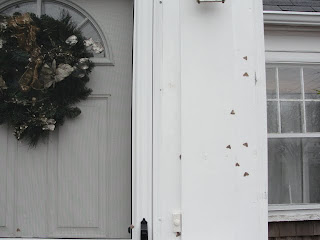 If you’re thinking you didn’t used to see moths on the Cape in November and December you are absolutely right. These little guys are natives of areas like Canada and have been moving south into our area over the last five or six years. This is their mating time and the swarms of moths you are seeing are males. The females do not fly and are mostly found crawling up tree trunks, front doors, etc. They look more like plain old bugs without wings and you probably wouldn’t think they were a moth at all.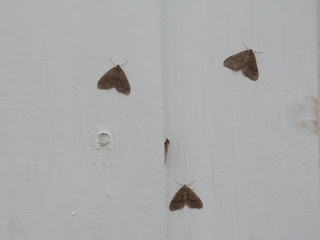
Male and female moths use pheromones to communicate with each other. These pheromones work like special scents to signal who is who and who is where. Female moths use pheromones like teenage girls and women use perfume to smell good and maybe attract a boyfriend. After the moths mate the female lays her eggs in the ground near or on the base of trees where they will stay all winter.
This all sounds pretty cool, right? Unfortunately the caterpillars (or larvae) of the winter moths hatch in the spring and climb up our trees and eat the leaf buds before the leaves can sprout, leaving many of our trees leafless all summer long. Eventually this will kill the tree so these moths are not a happy thing to find rising out of your lawn. The larvae go back into the ground to pupate (make a cocoon or crysalis) until late in the next year’s fall.
I have thousands of these moths around my house right now but there’s one thing that makes me feel better about it. So far I have seen only one or two females. Last year there were hundreds of females crawling everywhere! So maybe next year there will be fewer moths!
Blue-eyed Beauties
 One of the true pleasures of living near the sea is being able to find and eat fresh shellfish and other sea food. Bay scallops, also called Blue-eyed scallops may be one of the most favored and sought after of shellfish. Small, tender and sweet they make wonderful eating. When I was a child growing up on Cape Cod bay scallops were plentiful but these days they have become a much rarer find and are very expensive. It used to be that they would wash up on local beaches by the thousands after a good storm and the locals would be ready with buckets in hand to run along the shore to scoop up as many as they could as the tide receded. Sadly those days are long gone.
Bay scallops prefer eel grass beds and our eel grass beds are being overtaken by invasive seaweeds, polluted by boat fuels, septic overflows and other lovely things and overfishing as well.
If you are lucky enough to find a live scallop you will see its ring of bright blue eyes. Place it in a bucket of water and you will see it “swim” as it propels itself backwards by opening and slamming shut its shell.
Check south side beaches for scallop shells during the winter.
Oh, and don’t forget the true locals say “scollup” not “scaaallop.”
Do you know this bird?
Sort of looks like a small flock of Canada geese, doesn’t it? But it’s not!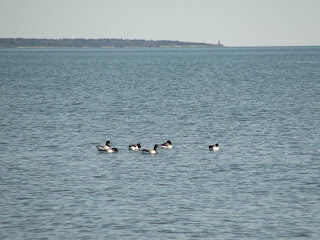 These small geese winter here and are especially easy to find along our south facing beaches where there is plenty of eel grass.
  Notice that the black on the neck goes all the way down the front of the bird and that there is no white on the face. These geese are called Brant and come here to feed in our open waters during the winter. In the spring they will head northward and nest on the Arctic tundra.
These birds were photographed at Craigville Beach in Centerville but may also be found at Kalmus and Sea Street Beaches in Hyannis, Dowses Beach in Osterville and other south facing beaches. They may also be found along the bay beaches if there is eel grass nearby.
Love those great blue herons!
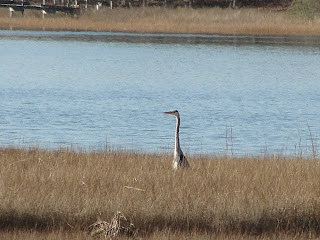 Life has been busy and I have been a negligent blog poster lately. I did get these fun shots of a great blue heron over the weekend, though….love that long neck!
This bird was photographed walking around Long Beach and the water is the Centerville River right at the Osterville line.
